
Escaping Project Churn: A Strategic Guide to Enterprise Sales in Construction Tech
Breaking down the 'RAMP' sales strategy for enterprise contracts

This article is written by Anton Marinovich who is a seasoned sales executive with over 20 years of experience in the SaaS industry, specializing in construction technology. He is currently the Chief Revenue Officer (CRO) for Joist AI and previously was the VP of Revenue at HoloBuilder leading up to its acquisition by FARO Technologies. He also serves as a mentor at the startup incubator, Formwork Labs, where he provides guidance to construction technology startups, leveraging his extensive experience in the AEC sector.
Most construction firms are federated organizations.
It means authority is distributed across regional or business units where each owns their own delivery and profit and loss. At the same time, they align to a central authority, sharing group wide standards, governance and long term strategy.
The value of this model is localization.
Construction varies based on geography due to regulation, labor markets, unions and suppliers. Federation allows firms to adapt locally while still operating under a shared brand and risk framework. It also allows for growth by acquisition as new entities can operate largely autonomously while aligning to overarching standards over time.
This autonomy is clearly visible on large projects, which often operate independently from one another even within the same company. That can mean different operating standards, processes and even, at times, cultures.
For us on the tech sales side it creates challenges.
Selling to a project in Texas may require a different process to one in New York, even though they sit under the same parent company.
I noticed this when I joined Holobuilder as VP of Sales & Customer Success in 2018.
As a reality capture platform, we initially sold at the project level, pricing by square footage. On paper, this looked great. We could show strong growth numbers and rising ARR to investors but it masked a deeper truth.
Project sales only last for the duration of the project, often 18 to 24 months.
That meant churn was built into the model. If I needed six new projects this month to hit revenue targets, I often had to sell ten to offset the four that were winding down. This churn made it difficult to raise venture investment.
To overcome this, we gradually shifted our focus to selling to the enterprise or parent brand.
We learned we could use a Project Led Sales (PLS) motion, proving value on live jobs across regions to build internal champions and reach the right decision makers. This opened the door to enterprise or head office conversations, allowing us to gain true ARR, reduce structural churn and ultimately helped position the company for acquisition by FARO.
In this article I’ll be breaking down the sales process, explaining the differences between project vs enterprise led sales, the pros and cons of each approach, the pricing strategies we used and how to navigate the shift from successful project outcomes to enterprise wide agreements.
Let’s begin.
Contents
What are Project Led Sales?
Enterprise Sales
Identifying the Magic Number
How to Price an Enterprise Agreement
The RAMP Method
How Construction Firms Allocate Technology Costs
What are Project Led Sales?
When I started at Holobuilder we were focused on project sales.
This is where we sold a contract deal for the lifetime or timeline of a single project. The budget would be linked to the project and we’d be selling to the Project Manager and teaching the Field how to use our solution.
The challenge that we faced is that we sold our reality capture solution based on the square footage of a project. This was an easy system to game and people would end up using it across all their projects at the flat fee.
It hurt our metrics as for one project level price, they’d use a system across a portfolio and then after the project winded down, we’d have to resell. My goal to fix this became singular:
How can we get revenue certainty?
To do this we explored Enterprise Sales.
Enterprise Sales
Enterprise sales are the holy grail of Annual Recurring Revenue (ARR) especially in ConTech.
It’s a company wide or package deal of multiple projects that are all tied to one contract. It is easier to manage and renew and there is only one contract rather than a portfolio of project contracts.
The value is that once a corporate is paying for your solution and it is mandated across projects, it’s incredibly sticky and difficult to churn.
We explored two personas to sell to:
Owners
General Contractors
For owners we explored convincing them to either buy a subscription and make the GC collect the data or mandate our technology in the specification. Doing the latter pushed the cost of our product into the construction process as the GCs would include it in their tender bids making it seem like it was ‘off the books.’
For General Contractors we offered two pricing options:
Subscription Fee
This would be a flat fee for use across their portfolio.Enterprise on the Go
Here we’d develop a Master Services Agreement where the head office aligns pricing and legal, every project that wishes to use the system can do so at the agreed rate.
We found that Owners were often willing to pay ~25% more than the GC due to budget and willingness to pay. The challenge was that there were less Owners interested.
With GC’s we realised there was a natural sales process where we could convert our project sales in one company into an enterprise wide agreement. It involved hitting a minimum number of project adoption which opened the door to an enterprise conversation.
Identifying the Magic Number for Enterprise Agreements
The first challenge we had was identifying when Head Office would be interested in an enterprise contract.
To identify this, we interviewed innovation managers at our clients and we learned that 5 to 10 projects implementing our solution and gaining value was the magic number.
At this stage the innovation team was able to create a business case for an enterprise contract and we’d initiate these conversations by either:
Asking for an introduction from the project team
Calling the innovation team and informing them of our current success
One trick we learned was that as soon as we win a project, we’d loop in the innovation team. Often the communication flow internally was slow so by informing and building the relationship from Day 1, the team would be ready to champion us once we hit the magic number.
How to Price an Enterprise Agreement
One caveat to selling to the enterprise is that you lose revenue potential for revenue certainty.
For example our average project sale was $10k. If a company had 20 projects that would be ~$200k in potential revenue.
When we talked to the enterprise, they’d be expecting a steep discount, often only willing to pay $100k on a flat fee. Additionally we couldn’t verify how many projects they’d be using the solution on as we can’t see their books.
The value for us however is that instead of having to negotiate 20 renewals every 18 to 24 months for each project, we’d only have to focus on one deal which had a 3 year contract life.
It also changed the nature of our stakeholder relationships to become:
Buyer: Innovation Manager / Enterprise Champion
Admin: Project Manager
Users: Field
From:
Buyer / Admin: Project Manager
Users: Field
For renewals the focus was now on the Buyer and customer support we’d continue to support the Admin and users. This is especially important to understand as the buyer may not be getting day to day value from the tool (as they are no longer the admin). It is important to keep them in the loop and to showcase success.
This contractual structure allowed us to show true ARR to investors and reduce our churn.
What we realised though is that venture investors would invest at higher valuations if we could showcase revenue growth within each account. And we achieved this by defining fixed growth metrics in the enterprise contract in return for a discount.
Here’s how it worked.
The RAMP Method
The RAMP method utilised the competing goals of our customers and investors:
Enterprise customers want the lowest price possible.
Investors want ARR and high growth projections.
This meant the latter was willing to provide investment and fund discounts for customers if it translated into long term ARR (valuation is a multiple of ARR).
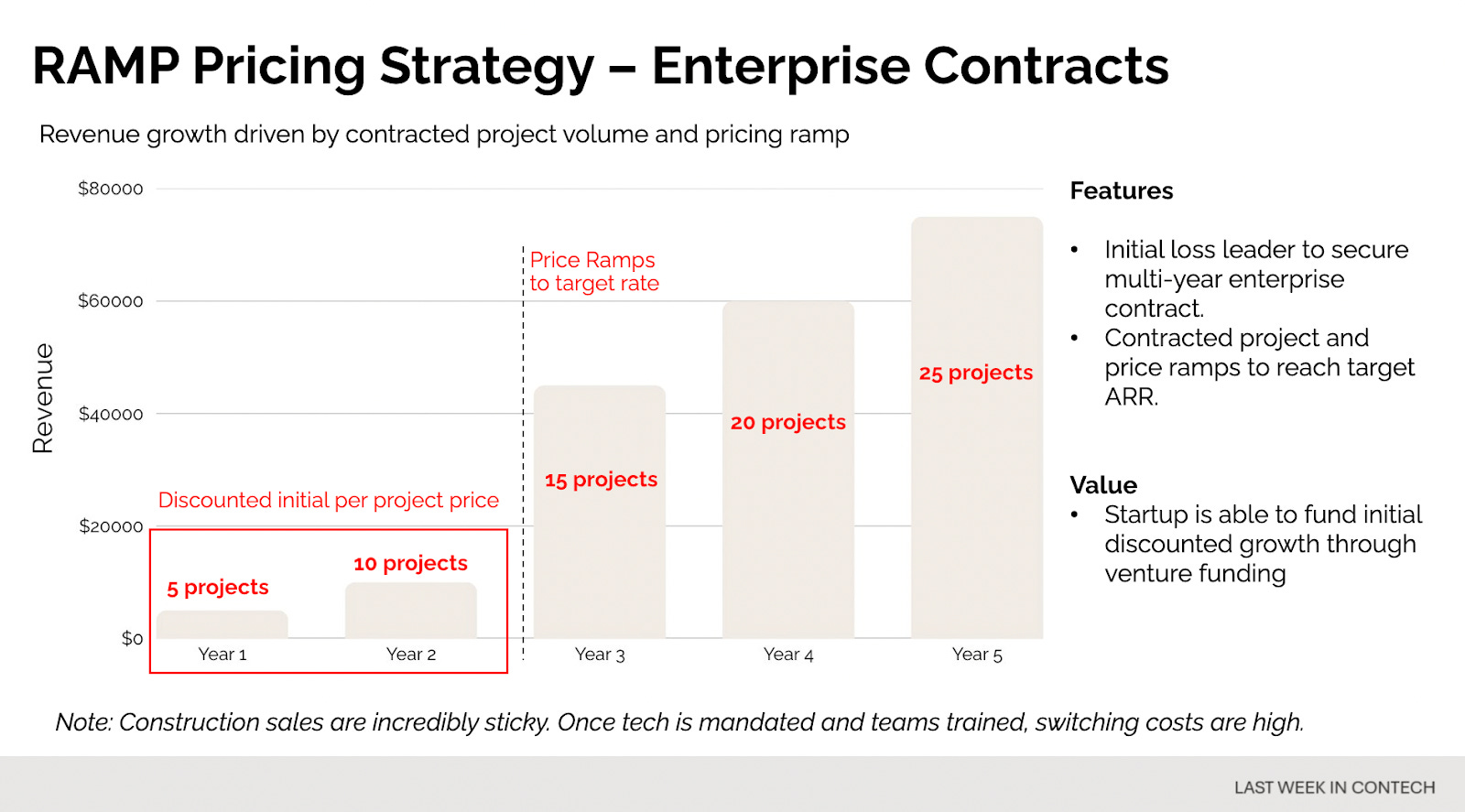
So what we did was that for each customer we estimated the number of projects they could use us on and developed a target revenue number.
We’d then sell a multi-year enterprise contract with a loss leader.
We’d sell an allocation of 5 projects for the first year at a significantly reduced price. This allowed them the opportunity to roll out the system at low cost. But then every year after, the contract ramps up to more project projects at a predefined rate to hit our desired price point / ARR goal.
This allowed us to close deals quickly and then show strong revenue projections in years 3 to 5 to investors. They were then willing to provide investment which allowed us to fund the initial contract cycle where we offered the deep discount.
How Construction Firms Allocate Technology Costs
As a final point, enterprise deals at large contractors are almost always initiated through an innovation or technology lead.
That person is not the final buyer. Their role is to build the internal business case for why the technology should be adopted and funded at the enterprise level rather than sold project by project.
This matters because once pricing moves to an enterprise contract, the cost shifts from individual projects to corporate overheads. If approved, that cost must eventually be recovered across bids and projects throughout the organization.
In practice, innovation teams often fund the first year of deployment using a dedicated budget. Subsequent years require the cost to be embedded into bids, margins or regional Profit and Loss.
This is where the RAMP model works.
The discounted first year stays within the innovation team’s budget, enabling low friction approval and rollout. The contracted ramp then gives the organization time to operationalize the technology and systematically distribute the cost across future bids.
The shift from project-led sales to enterprise agreements is a response to how construction firms actually operate.
Federated organizations fragment decision making at the project level, while centralizing standardization and budget authority at the enterprise level.
Project Led Sales is the most effective entry point into these organizations. It proves value in live environments, builds trust with delivery teams, and generates the internal evidence required to justify wider adoption. But on its own, it is not a scalable revenue model.
Enterprise sales is where that value is consolidated and the trade-off is clear. We give up upside per project in exchange for revenue certainty, deeper integration, and stronger retention.
Navigating this transition requires understanding a few key dynamics:
Enterprise deals are earned through repeated project success, not top-down persuasion
Internal champions, especially innovation teams, bridge project adoption and corporate approval
Pricing is a negotiation between short-term revenue loss and long-term ARR expansion
Adoption and cost allocation inside the customer matter as much as the initial sale
Ultimately, the goal is not to replace project sales but to use them deliberately whereby project sales generate proof and enterprise sales capture value.
The son of a Croatian bricklayer, Anton Marinovich spent his youth laying bricks alongside his father, developing a hands-on understanding of the trades. Today, he merges that lifelong passion for building with a love for technology, bringing over 20 years of SaaS leadership to the construction tech space. Currently serving as the Chief Revenue Officer (CRO) at Joist AI, Anton previously drove revenue growth at HoloBuilder, guiding the company through its successful acquisition by FARO Technologies. He continues to champion industry innovation as a startup advisor and a mentor at Formwork Labs, where he helps early-stage founders build the future of construction.