

Deep Insight: Is AI increasing innovation in ConTech?
When AI first emerged it promised a software renaissance.
Tools like GitHub Copilot and Claude Code dramatically reduced the cost and time required to build software. Ideas that took months to prototype could now be turned into working products in days and the expectation was that we’d see a cambrian explosion in tooling for construction.
But the reality has been much more nuanced. The constraint is no longer whether software can be built, but rather the customer’s ability to absorb it.
It’s a comment which came up in a recent conversation with Cameron Page, the founder of Clearstory, a change order management platform. When he outlined their feature release cycle, it became evident that software development is only a small part of the deployment journey.
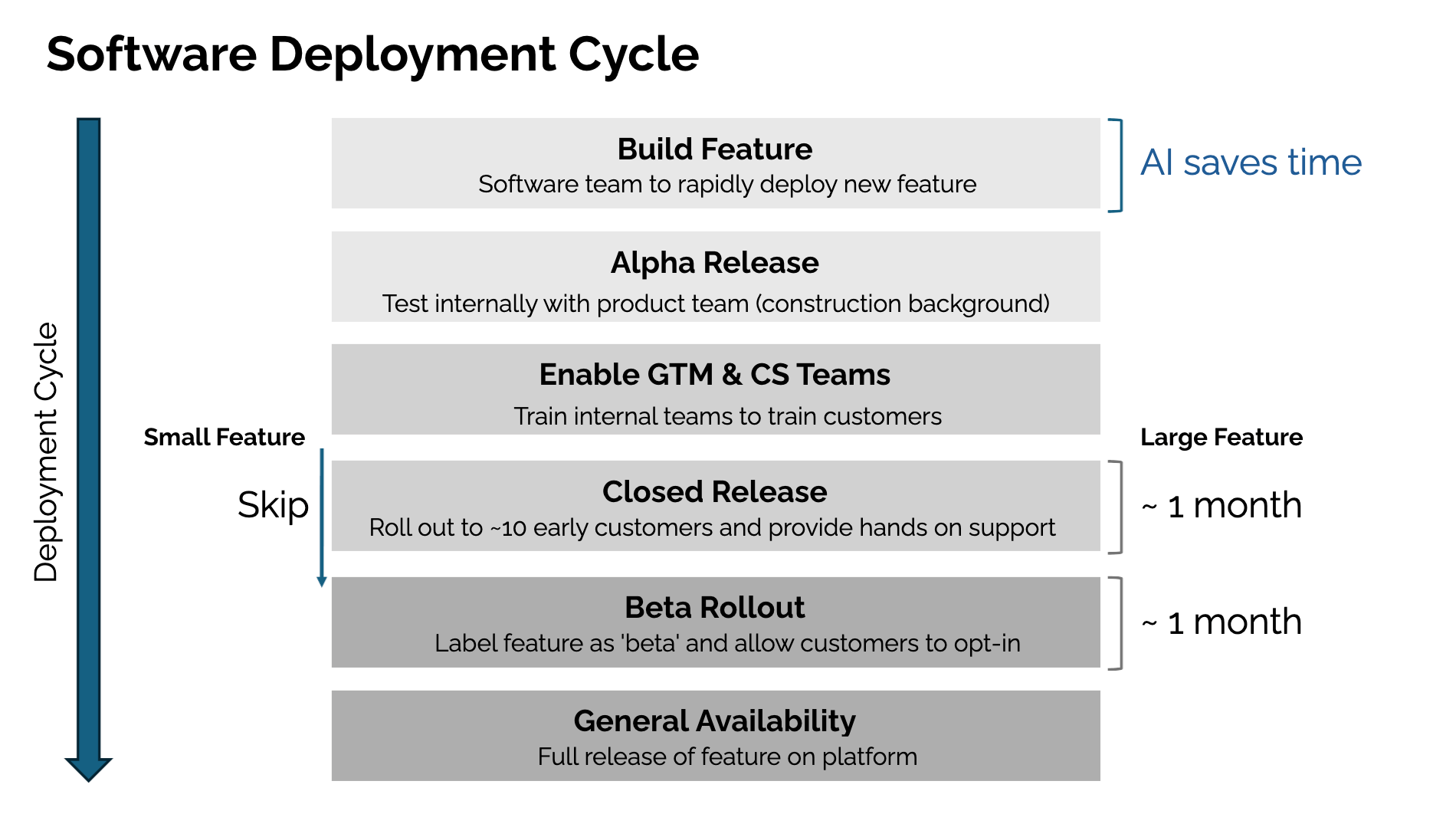
Before a feature reaches general availability, it still requires testing, internal enablement, customer training, documentation, support resources, and deployment planning. Even with AI accelerating development, large releases can still take months to move from concept to widespread user adoption.
It means that the bottleneck isn’t engineering velocity but adoption velocity which changes the nature of product strategy.
When almost anything can be built quickly, deciding what to build is more important as customers have a limited capacity to learn new workflows, evaluate new features, and incorporate them into their daily operations.
So how can we increase customer absorption capacity?
One of the best examples I’ve seen of solving this challenge comes from Beehiiv, a newsletter platform.
They release new features almost every week and what’s interesting is how they educate and make their customers aware of the changes. They do so by utilizing multiple channels including:
The underlying thesis is that shipping velocity only matters if customers can discover, understand and adopt what you’ve built. Their education and distribution layer acts as a force multiplier on product development, shortening the gap between feature release and customer adoption.
It’s a lesson that many ConTech startups could utilize as we often rely heavily on customer success teams and live training to drive adoption. As development becomes cheaper and faster, the competitive advantage may shift away from building features and toward helping customers discover, understand and operationalize them.
So while AI is making tools easier to create, the challenge now is making it easier to absorb.
In this issue there are:
8 Startup Fundings
1 Startup Emerged from Stealth
17 Policy and Regulatory Changes
7 New National Infrastructure Projects & Priorities
1 New investment funds
2 Acquisitions
6 News articles
52 new jobs posted - view here
Reading time: 13 mins
Startup Funding
Water
Solinas Integrity, an Indian startup, raised $5.5m in funding. They develop robots to inspect, clean and digitize underground water and wastewater infrastructure assisting with activities such as defect identification and asset management. More here.
Reality Capture
NavVis, a German startup, raised $85m in funding. They are building a spatial data platform for the built world, combining their mobile reality capture solutions with their enterprise digital twin platform allowing project stakeholders to view accurate and trusted reality information to reduce waste, rework and downtime. More here.
SiteVue AI, a Tennessee startup, raised $7.5m in Seed funding. They have developed proprietary fixed and wearable AI-enabled cameras that analyze environments in real time providing information on defects, labor activity, injuries, PPE compliance and more being able to send alerts to workers or supervisors. More here.
Notes:
SiteVue has been initially focused on automotive manufacturing and food production industries.
They are now expanding into construction,oil and gas and other industries.
Supply Chain
Fitting, a Saudi Arabian startup, raised $1.1m in Seed funding. They are building a supply chain platform that seeks to automate and digitize the procurement process connecting contractors, suppliers and developers and providing centralized resource coordination and optimizing logistics tracking. More here.
Finance
Ambrook, a Colorado startup, raised $30m in Series B funding. They are building accounting software for independent family run businesses in the ‘real economy’ having started with agriculture and expanding to construction providing real time profitability tracking, payment and invoice management, multi-user expense tracking, automated bill pay and a mobile application. More here.
Equipment
AMDB Security Pro, a French startup, raised $3.1m in Seed funding. They have developed a patented anti-theft device for heavy construction equipment which is compatible with over 100 brands of mini-excavators and construction equipment. More here.
Architecture
Visoid, an Oslo startup, raised $2.5m in Seed funding. They are developing an architectural visualization platform designed to help architects and designers transform existing 3D models into high-quality visualisations offering features such as adjusting lighting conditions, switching materials and seasonal settings to explore different ideas and communicate designs without relying on traditional rendering processes. More here.
Other - Procurement
Fluxco, an Austin startup, raised $26m in Seed funding. They are building an AI powered procurement platform for electrical transformers, allowing clients to upload engineering requirements, receive vetted bids from their global OEM platform, evaluation and coordinate delivery. More here.
Notes:
Lead times for large power transformers in the US is at 128 weeks and generator step-up units at 144 weeks.
Transformer prices have risen 70–150% since 2020.
This is impacting data center construction.
Out of Stealth
Zenbild, a Miami startup, emerged from stealth. They are building an AI powered communication platform for GCs providing features such as task management, multilanguage field communication support and project document management. View the website here.
Policy and Regulatory Changes
US
Trump Refunds to Cancel Offshore Wind Projects Total $4 Billion
The administration has reached agreements with six developers to surrender offshore wind leases and redirect reimbursed funds to fossil fuel projects and other investments.
More than 20 leases valued at nearly $2 billion remain outstanding, making more agreements likely in the coming months.
More than 15 gigawatts of offshore wind capacity across 16 projects was withdrawn from grid operators’ interconnection queues last year alone.
The Pentagon’s wind farm blockade is over — for now
The U.S. Department of Defense has for months refused to conduct routine military evaluations of proposed onshore wind farms, creating a de facto moratorium.
A federal judge ordered the agency to resume its reviews.
The preliminary injunction requires the DoD to report to the court on its progress every 30 days while the legal case proceeds.
Notes:
The DoD delays, which began in August 2025, have affected more than 155 projects across 21 states.
Energy Department cancels 3 national transmission corridors selected under Biden
The Trump administration said it would cancel three proposed federal transmission corridors.
The corridors program is meant to help expand electric transmission by designating geographic areas of particular congestion.
A designation helps unlock federal financing and permitting tools for projects located within the corridors.
Senator introduces bill to prevent construction worker suicide
A Democrat Senator has introduced legislation to prevent deaths by suicide among construction workers and to better understand the mental health crisis the industry faces.
It would authorize the Health Secretary to conduct a national study through The Centers for Disease Control and Prevention.
The initiative would collect data on suicide risk factors construction workers face, then inform prevention strategies.
Notes:
When measured by industry, construction frequently has one of the highest rates of deaths by suicide.
The fatality rate from suicide for construction was 43.2 per 100,000 workers in 2024.
Seattle Opens $110 Million Funding Round for Affordable Housing Development
The 2026 Rental Housing Production Notice of Funding Availability, released on July 20, invites applicants to compete for capital funding supporting projects.
Proposals may include new affordable housing construction, rehabilitation of existing buildings, or acquisitions that preserve affordability over the long term.
Earlier this year, the city awarded $155 million through its 2025 NOFA, supporting more than 2,100 affordable homes across 20 developments.
Legislative committee puts new Maryland building code on hold amid environmental concerns
A Maryland legislative committee is holding up a new building code regulation amid concerns that it is less environmentally stringent than the national code.
Environmental organizations and energy think tanks expressed that Maryland’s version of the code for large commercial buildings allowed far more flexibility on energy efficiency measures.
Pennsylvania targets $90B infrastructure investment over 12 years
Pennsylvania’s State Transportation Commission has adopted a plan to inject $90 billion into the state’s infrastructure work over the next 12 years.
The funds will go toward improvements to roads, bridges, transit systems, airports, railroads and active transportation.
It represents a more than 3% increase from the 2025 iteration of the 12-year program.
The Building Energy Performance Standard is one of the first such attempts to regulate energy upgrades for existing buildings.
It has come up against the massive cost of retrofits and opposition from owners of historic buildings.
D.C. Department of Energy and Environment has now softened its stance, making some
They stated
“The agency now says it will waive penalties if a building’s owners are making a good faith effort to satisfy the law. And instead of paying a fine, owners can use that money to pay for efficiency upgrades that the law requires.”
Denver wins lawsuit over its new electrification requirements for commercial buildings
A federal judge dismissed an industry lawsuit that aimed to strike down city requirements regarding how water and air heaters are powered in commercial buildings.
The city argued its laws were meant to mitigate the health and climate impacts of burning fossil fuels and using inefficient resistance heaters.
Notes:
The standards that took effect in 2024 barred new commercial buildings from using space and water heaters that relied on fossil fuels or electrical resistance, with some exceptions.
Commercial buildings could include apartments, restaurants, hotels and more.
Single-staircase reforms aim to boost middle-scale housing in Michigan
Michigan Gov. Gretchen Whitmer signed two bills last month that update the state’s construction code to allow for single staircases in more multifamily buildings.
One bill increases the number of stories in buildings permitted to have a single staircase from three to four.
The other allows for single staircases in buildings with fewer than six stories that are served by an accredited fire department.
The reforms are expected to reduce construction costs by upwards of 10%.
FAA earmarks $870M for airport infrastructure projects
The agency will distribute 339 grants to airports in 44 states and two territories through its Airport Infrastructure Grants program.
This falls under the $1.2 trillion Infrastructure Investment and Jobs Act.
Europe
EU-backed roadmap aims to fix Ukraine’s acute construction labour shortage
The Roadmap for Skilled Workforce Provision in Ukraine’s Construction Sector 2026–2030 sets out measures intended to build a long-term training system.
It seeks to better match what employers need.
Employers report that existing training programmes often do not reflect modern technologies, materials, equipment and work organisation.
It means graduates frequently need additional practical training once hired.
India
Govt. plans expansion of ‘green development’ to all ordinary buildings
Principal Secretary of Andhra Pradesh (Municipal Administration & Urban Development) unveiled the government’s ‘green urban development agenda.’
It comprises an incentive framework for sustainable buildings, Artificial Intelligence (AI)-enabled planning approvals, simplification of regulations and performance-based green certification.
One reform is the offering of development charge discounts of 5% for silver-rated buildings and 10% and 15% for gold and platinum-rated buildings respectively.
This is aimed at building environmentally responsible and globally competitive cities under the Swarna Andhra-2047 vision.
Notes:
Swarna Andhra-2047 is a long-term strategic development plan for Andhra Pradesh.
It aims to transform the state into a $2 to $2.5 trillion economy with a per capita income exceeding $42,000 by 2047.
31 illegal buildings demolished in Gurgaon for violating norms
This included under-construction and residential buildings, during a citywide enforcement action against unauthorised construction and violations of building bye-laws.
Encroachments were also cleared from roads and public spaces.
It marked the first day of a month-long enforcement campaign launched in compliance with the directions of the Supreme Court and the Municipal Corporation of Gurgaon commissioner.
Canada
Ottawa launches $100-million steel shipping rebate program as U.S. tariffs weigh on industry
The federal government is launching a $100-million rebate program that will partially subsidize the interprovincial shipping costs of Canadian steelmakers.
Effective immediately, the program will rebate 50 per cent of eligible rail or marine transportation costs for Canadian steel moving between provinces and territories for up to one year.
Notes:
This could have an impact on construction input costs.
Australia
NSW building reforms sees new legislation for prefabricated buildings introduced
The New South Wales government has passed a Bill outlining a regulatory framework and streamlining the approvals process for prefabricated buildings delivered via modern methods of construction (MMC).
It recognises MMC in law by defining “prefabricated buildings,” integrating into the building approvals system and setting rules for manufacture, supply, transport, delivery and installation.
This is the first Australian jurisdiction to have formally recognised MMC in law and integrated them into the approvals system.
The government believes MMC has the potential to reduce overall building costs by up to 20 percent, and result in homes being built up to 50 percent faster.
Singapore
Singapore Clears Plans to Import Clean Energy from Malaysia
Singapore granted two companies conditional approval to import renewable power from projects planned in Malaysia’s Johor state.
Singapore depends on imported natural gas for most of its electricity and has approved plans to import clean power from countries including Indonesia, Malaysia, Australia and Cambodia.
National Infrastructure Projects & Priorities
US
Tesla and SpaceX will invest $16.8B to start building ‘Terafab’ chip factory in Texas
The facility has more than 100 million square feet of manufacturing space planned.
SpaceX has suggested in filings that it may spend as much as $119 billion on the project across a “multi-phase” construction plan.
Bank of America pledges US$250B for U.S. infrastructure financing
Bank of America said it plans to deploy US$250 billion by July 2027 to support U.S. digital and infrastructure projects.
Notes:
The announcement comes days after Morgan Stanley MS.N said it would facilitate roughly $1.5 trillion over the next decade to finance technology and infrastructure projects.
Last year JPMorgan Chase launched a $1.5 trillion plan to facilitate, finance and invest in industries deemed critical to the U.S. national security and economic resilience.
California produced over half its May electricity from solar, a world record
It’s the first time a large-scale power system is known to have surpassed 50% solar for an entire month.
Since 2020, the energy provided by battery storage in California has grown from 500 megawatts to 16,000.
California had about 23,400 megawatts of utility-scale solar capacity.
When you add in rooftop and other small-scale panels, California has ~43,500 megawatts.
China
Inner Mongolia Emerges as China’s AI Infrastructure Hub With World’s Largest Facility
Chinese clean-energy company Envision Group has completed the world’s largest single artificial-intelligence computing facility in Ulanqab.
They have completed the first phase of a facility in Ulanqab spanning 120,000 square meters (roughly the size of 20 soccer fields).
Envision has set a goal of building clean-energy AI computing centers totaling 5 gigawatts in desert regions worldwide by 2030.
Vietnam
Around $11 bln proposed for capital region’s projected Ring Road 5
The proposed Ring Road 5 will span approximately 349 km, passing through seven provinces and cities.
The central budget will contribute over VND215.19 trillion (nearly $8.2 billion) for the main expressway.
VND73.076 trillion ($2.78 billion) for the parallel roads will be financed by local provincial budgets.
According to preliminary plans, the project requires the reclamation of approximately 4,011 ha of land.
Australia
Australia promised 1.2 million new homes, but builders are at their limits
The government promised to deliver 1.2 million new homes by 2029.
It combines billions in federal funding with state commitments to fast-track approvals, rezoning and land releases for new developments.
However, two years since the agreement began, completed home construction sits 27% below the 60,000 dwellings needed on average per quarter to hit the target.
Completing a new apartment now takes 33 months compared to 21 months a decade ago, while a house takes 11.5 months, up from 8.6 months in the same time frame.
Hungary
Hungary braces for a full shutdown of the Paks nuclear plant as the Danube River hits record lows
Hungary’s only nuclear power plant will shut down for the first time in its history due to record-low water levels on the Danube River.
The plant uses water from the Danube to cool its reactors, but the exceptionally low water level has tested the ability of pumps to bring sufficient quantities into the plant.
It accounts for nearly half of Hungary’s electricity production.
Investment funds
Imad Ventures, the corporate venture capital arm of Nesma & Partners, a Saudi Arabian company, announced a new fund supporting the transformation of the construction industry. Their focus is on technologies harnessing AI, advanced materials, and digital innovation to meet the evolving demands of modern construction. More here.
Acquisitions
ENG, the largest BIM service provider in the U.S. providing VDC services to MEP and General Contractors, Owners, and AE firms, has acquired e-verse, a software development company focused on building AEC specific bespoke products and made up of architects and engineers who can code. More here.
Caterpillar, an American construction, mining, and other engineering equipment manufacturer, acquired Skycatch, a geospatial data and drone analytics company which provides aerial data capture, 3D mapping, and digital twin technology for large-scale industrial, construction, and mining operations. More here.
Notes:
Skycatch was a portfolio company of WND Ventures, the corporate venture capital arm of DPR construction.
News
Data center developer offers over $4M per acre to buy out homeowners
Data center builders are outbidding home builders for land.
In one case, a developer offered home owners in Virginia about $4.4 million per acre for their land in an area where median land prices range closer to $100,000 per acre.
Beijing may be adapting its influence playbook for America’s infrastructure debate
A report by OpenAI explained how the company disrupted a Chinese-linked influence operation that used ChatGPT to generate fabricated social media posts opposing American AI data centers.
Americans are rallying against data centers. Surprisingly few are actually getting built
Only about half of the AI computing capacity scheduled to activate between now and 2028 via data center construction is actually expected to come online by its target date.
A labor shortage is choking off AI data center construction
By some estimates, the U.S. is 58,000 people short of the workforce needed to install the fiber-optic cable that connects data centers to the internet.
A.I. Companies Are Recruiting Electricians and Carpenters by the Thousands
If I missed anything this week, please reply and let me know! I’ll make sure to include it next week.
The 58,000-worker gap on fiber install is the part of the data center story that does not get covered. We run a job board for traveling trades workers and see it from the other side - the crews doing this work already live on the road, and the work moves state to state as each build finishes. Pay and per diem decide where they go next, so any workforce fix has to price that in or the crews just follow the better per diem to the next project. Our board is here if it is useful to anyone reading: https://roadtrades.com/jobs/
Very impressive coverage of contech news, both in geography and topics 👌