
The Construction Stack Is Being Rebuilt
Unpacking Brick & Mortar Ventures Construction AI thesis.

Founded in 2015 by Darren Bechtel, Brick & Mortar Ventures is a venture capital firm that invests globally in startups that develop software and hardware solutions for the architecture, engineering, construction and facilities management industries.
This article is written by Kaustubh Pandya, General Partner and Aditya Thakur, Venture Partner with support from Bhragan Paramanantham, author of Last Week in ConTech sharing how they see AI reshaping construction.
PART I: From Platforms to Project Operating Systems
“AI is already at work in your business. The real question is: who’s steering it?”
This reality came into sharp focus at our last Investor Summit when OpenAI’s CRO shared data from a sample of our partner firms in the room showing widespread personal account use in their organizations. It only confirmed what many leaders already suspected.
From construction sites to corner offices, employees are already using AI to draft contracts, process RFIs, run material take-offs, and build RFPs, often without leadership’s knowledge. The industry has always adopted useful tools from the ground up before official buy-in: digital blueprints, punchlists, reality capture, and countless unofficial spreadsheets that quietly became operational infrastructure. AI is following the same path with a bigger blast radius. It delivers real utility, turning a messy field note into a usable RFI draft in seconds, alongside real risk, confidently missing the detail that makes the answer unusable. That mix of immediate utility and uneven reliability is why the firms leaning in early, thoughtfully, will look very different from the ones that ignore it.
The risk isn’t hypothetical. Sensitive project data (contract terms, pricing, trade partner performance, client details) may already be flowing through consumer grade tools without policy, training, or data governance in place. But the upside is real too: field teams are validating use cases on their own, without waiting for procurement cycles or enterprise roadmaps, because the pain is visible and the relief is tangible.
For an industry that has been promised connected platforms, paperless jobsites, predictive analytics, and full digital twins, and often got yet another login, that bottom-up pull is rare. It deserves attention because AI maps unusually well to construction’s deepest operating problem: the gap between enterprise standardization and project specific reality.
A $16 trillion Industry Made of Companies That Only Exist Once
Construction is one of the largest industries in the world, roughly $16 trillion and growing. It remains difficult to digitize because the basic unit of production is the project.
Each project is essentially a temporary company: a one-off team, schedule, site, and supply chain assembled for a finite window, with critical knowledge living in a foreman’s head, a markup, or a conversation next to the hoist at 6:12 a.m. This is the industry’s n of 1 problem. Every project is unique enough to resist standardization, while similar enough that firms know lessons should travel better than they do.
That tension has produced decades of compromise, point solutions, platforms, and a sprawl of spreadsheets, because no architecture has reconciled enterprise control with project-level autonomy.
AI changes the equation: it enables project-specific “operating systems” that stay connected to enterprise data while adapting to local workflows and increasingly acting across tools. Solution providers could always meet the field one tool or one workflow at a time, but a fit-for-purpose stack per jobsite rarely cleared the ROI bar. That just changed. Our working view: the advantage will accrue to firms that embed AI into execution turning their way of working into a durable, structural advantage. Tool counts, pilot announcements, and innovation theater will matter less than workflow quality, data readiness, process discipline, and AI training for the workforce.
Construction has Always Bought Technology Differently
At Brick & Mortar, we often joke that there is B2B, B2C... and then there is B2Construction.
Construction has never bought technology the way most industries do. It usually starts in projects and eventually scales to enterprise. Construction cares far more about reducing project risk than maximizing feature depth. At the same time, it’s an industry deeply comfortable with subcontracting. Packaging capability as a service is the industry’s native procurement motion.
Those buying behaviors are starting to show up in GTM approaches for AI solutions. Most of the early AI traction we see falls along a spectrum, anchored by two archetypes:
AI-enabled service providers: firms that use AI behind the scenes to deliver turnkey outputs, often replacing or augmenting services that were already outsourced.
Workflow-embedded AI: solutions that slot directly into existing processes and tools, delivering immediate value without forcing teams to change how they work.
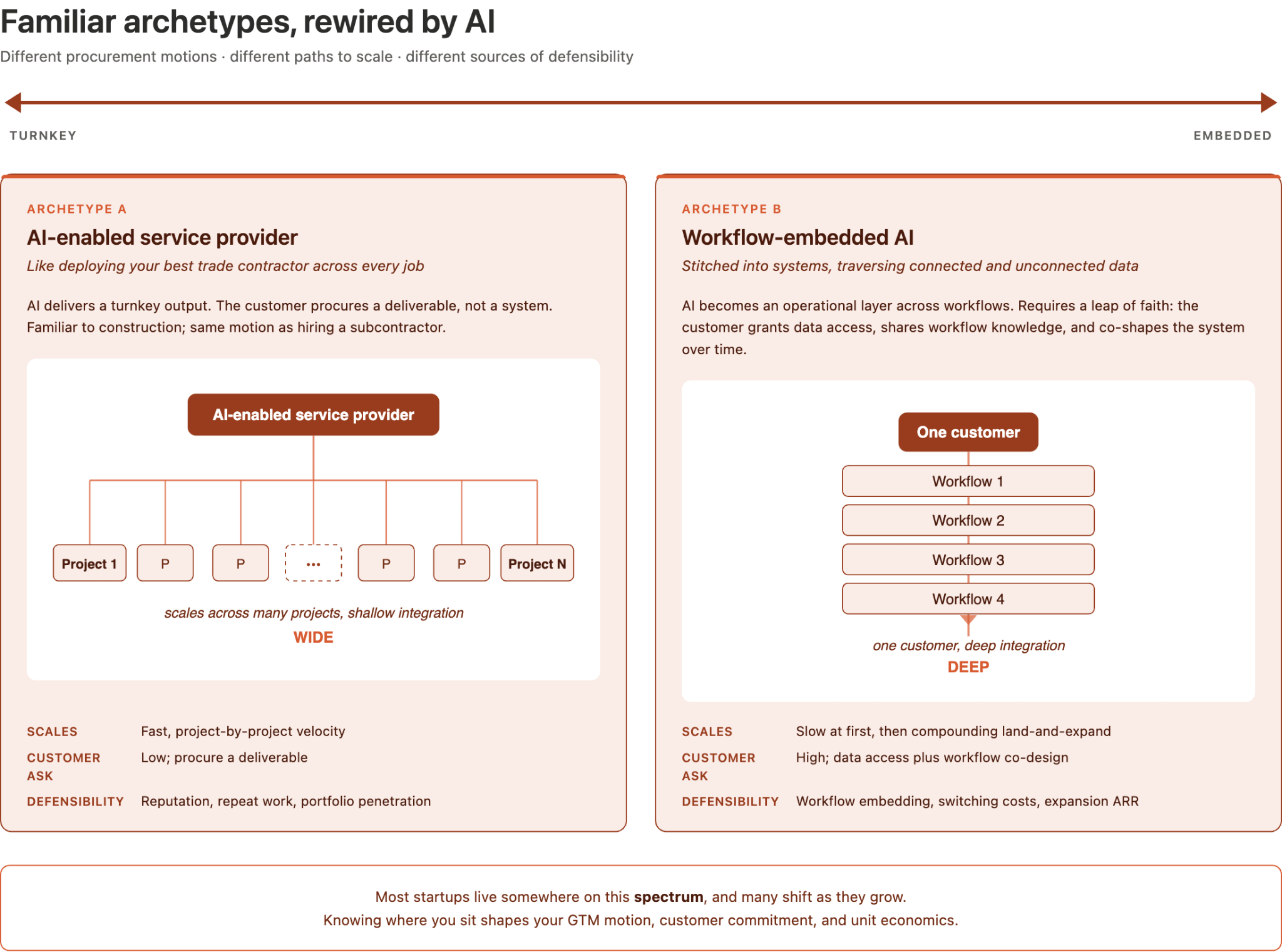
The two ends place very different demands on the customer.
AI-enabled services are low friction; they ride on the subcontracting motion the industry already knows. Workflow-embedded systems carry a heavier diligence lift for customers. With traditional SaaS solutions, customers could pilot a few options across 3-5 projects and adopt the best fit; they rarely diligence the technical core. With agentic systems, that diligence burden is upfront. Before they see ROI, customers must parse unfamiliar terms such as context graphs and ontologies, deciding which startup to partner with and trust with their data and workflow knowledge. The difference: even point-solution or single workflow related sales become an enterprise type conversation, closer to onboarding a deep partner than closing a pilot.
These dynamics, low-friction services on one end and partner-level commitments on the other have deeper implications for founders on GTM approaches, defensibility, talent needs, and capital requirements.
The classic construction tech playbook was to pursue a steady build with a point solution, grow to $5M and then explore multi-product offerings on the way to $10M. Agentic AI can compress the arc though it requires more upfront. Customers have to take a leap of faith on the provider, sharing data, opening workflows and allowing the system in. When it fits, the customer pulls the solution into adjacent workflows immediately. And because the integration work is already done (even if partial), each new workflow is cheaper to win than the last. Expansion can happen earlier in the customer journey. Instead of selling the same point solution to more customers, startups get pulled into more workflows for the same customer. That pulls product, sales, and customer success closer together than in a typical SaaS motion.
On the other end sit AI-enabled service providers, an archetype we think is underrated in construction. In most industries, this play still means a long sales cycle, because the commitment happens at the organizational or business unit level. For construction, it’s at the project level, so the buying hurdle is more bite-sized. Revenue can scale faster than the traditional project-by-project SaaS motion, at least until you go enterprise. If it holds, it points to a “land and explode” dynamic: a couple project wins spreading across the customer’s whole portfolio. It is essentially owning a line-item on a project budget. For customers, it’s akin to scaling your best trade partner (or vendor) across all your projects.
As these GTM models take hold, contractors are rethinking procurement and implementation and building the foundations to compete in an AI-driven industry (we will cover this in Part II).
Both archetypes are really just two GTM patterns sitting on top of a much bigger shift driven by AI. It is worth zooming out to see how founders are voting with their time and how customers are voting with their dollars when it comes to AI.
Construction Is Absorbing All Three Layers of AI, Just Not at the Same Pace
The state of AI in construction is moving quickly enough that any snapshot will age in as little as six months. Even so, the current market can be understood through three broad categories: generative AI, physical AI, and agentic AI (original framework shared by NVIDIA at CES 2025).
Each will reshape the industry differently. And against the backdrop of a data center construction boom and a perennial labor shortage, each is being pulled in faster than the industry’s usual pace.
Generative AI: Unlocking the Unstructured Archive
In construction, ‘generative AI’ can stretch to cover AI-generated 3D models. For this article, we will stick primarily with LLM-driven applications. And the reason they matter in this industry is specific: construction is data intensive and collaboration heavy. Even a decade ago, before the wide-spread adoption of digital tools, a study by BOX put construction as one of the most data consuming and creating industries. Every stakeholder needs to collaborate but also wants its own trusted data source and system of record. Digitization of the industry over the past decade has only created more data to share, store, and analyze. However, most (if not all) of this data is not structured for ease of use and is often siloed. GenAI is empowering the industry to start using this unstructured data.
Early generative AI adoption in construction is clustering around three levels of workflow involvement: understand, produce, automate.
Understand: making sense of the project
These tools help teams turn fragmented project information into usable context. These solutions leverage AI to surface insights and guide users through complex tasks without replacing human judgment. Common use cases include searching across project-specific data (such as contracts, RFIs, or specifications) or tapping into unstructured knowledge from past projects. Solutions based on a single data source or system are increasingly common; building a rich and accurate contextual understanding of a project across multiple data systems remains a challenge. A key differentiating feature can be if you own the data-set or help capture data that was previously not captured. As an example from the asset operations phase, OmniAI by Zerokey enables instantaneous interaction with factory floor production data enabled by its unique microlocation data capture.
Produce: drafting with a human in the loop
Human-in-the-loop tools where AI assists but does not operate autonomously. These solutions accelerate content creation and workflow execution while minimizing the opportunity cost of “getting it wrong.” Examples include drafting proposals, developing RFP responses, or translating standard operating procedures into digital workflows. Check out workflow builder by Cumulus Digital Systems as an example.
Automate: bounded tasks, tight oversight
Applications that automate well-defined tasks with strong quality oversight on output. Examples include take-offs, bid leveling, submittal review, and structured scope analysis. Data can remain siloed or at a project level. Most of these systems still rely on human approval before downstream actions are taken, placing them closer to generative AI than full agentic AI. They represent an important stepping stone: once these tasks become reliable enough to trigger subsequent actions across multiple systems, they evolve into agentic workflows. Delivering customer value here still takes domain expertise: Drawer, focused on electrical take-offs, is a good example of bounded task automation (though not an LLM-based solution).
Most startups naturally expand across these capabilities to provide customer value. For example, Planera’s AI assistant Manny traverses checking schedule health, creating what-if-scenarios, and changing the schedule (with customer’s permission). A single user productivity tool has limited lock in. Products become more durable when they support collaboration (internal and external), capture unique data, or become tied to measurable operating outcomes.
A bigger unknown lies in the long-term gross-margin profile and viability of these businesses. Application layer AI companies depend on foundation models whose pricing is still evolving. Each use case will face the vitamin or painkiller test as solution providers iterate on models (latest and greatest vs open-source) and pricing strategies.
Physical AI: Bringing Intelligence to Machines
An investor once put it to us plainly: no matter how good the software is, it doesn’t put work in place. That gap is where physical AI lives, and the labor shortage makes it the category with the clearest pull. From task-specific purpose-built robots to retrofitted equipment running autonomously, the barriers to building for the jobsite are falling fast: hardware costs are down, spatial AI has made perception workable in dynamic environments, and imitation learning lets machines pick up complex tasks by watching human operators.
Construction-related robotics has attracted more funding in the last couple of years alone than in the previous decade combined. We will be covering this space more deeply in the future, as it continues to evolve and reshape how construction work gets done.
Agentic AI: From Task Automation to Workflow Orchestration
Generative AI helps people complete individual tasks. Agentic AI coordinates work across tasks, systems, and stakeholders. It retrieves information, reasons across changing conditions, and acts within defined permissions to pursue an objective, not just produce an output.
In construction, an agent might detect a delayed delivery, assess the schedule impact, notify affected teams, update the daily plan, and flag procurement or labor consequences. This area of AI presents a significant opportunity but the industry isn’t yet structurally prepared to adopt it.
Model Context Protocol (MCP) is becoming the connective layer for this future and being adopted by the industry at a rapid pace. To put it in perspective, APIs took years to become the adopted protocol. MCP was announced just two years after the launch of ChatGPT and already welcomed by the industry. MCP gives agents a structured way to access tools, services, and data sources and with the right permissions, agents could reason across Autodesk, Procore, Oracle, Microsoft Teams, safety systems, equipment records, finance platforms, and document management tools.
Why The Current Stack Is Exhausted
Stakeholders in construction have long searched for solutions to a set of recurring problems:
Siloed data
Digitization began with point solutions; specialized tools designed to solve narrow problems. Over time, teams became fatigued by juggling too many disconnected systems with little interoperability. As a result, the industry often settled for “good enough” integrated platforms instead of adopting best-of-breed tools, unless the ROI of a point solution was overwhelmingly clear.
Rigid systems
Most platforms were built with a specific vertical or project type in mind (e.g residential, commercial, or infrastructure) and do not scale easily across the full range of work a typical construction firm manages. High licensing and implementation costs further push firms to standardize on a small set of systems across all projects. The outcome is suboptimal: teams are forced to prioritize cost and compliance over fit-for-purpose solutions tailored to project needs.
Cumbersome workflows
Together, these “existing conditions” created workflows where people adapted to the software instead of software adapting to them. It is no surprise that there is little interest to reinvent the workflows if it was primarily getting in the way of putting work-in-place rather than helping the use-case of interest.
Let’s take a look at a sample high-level illustrative tech stack of typical projects today (real tech stacks are much more complicated).
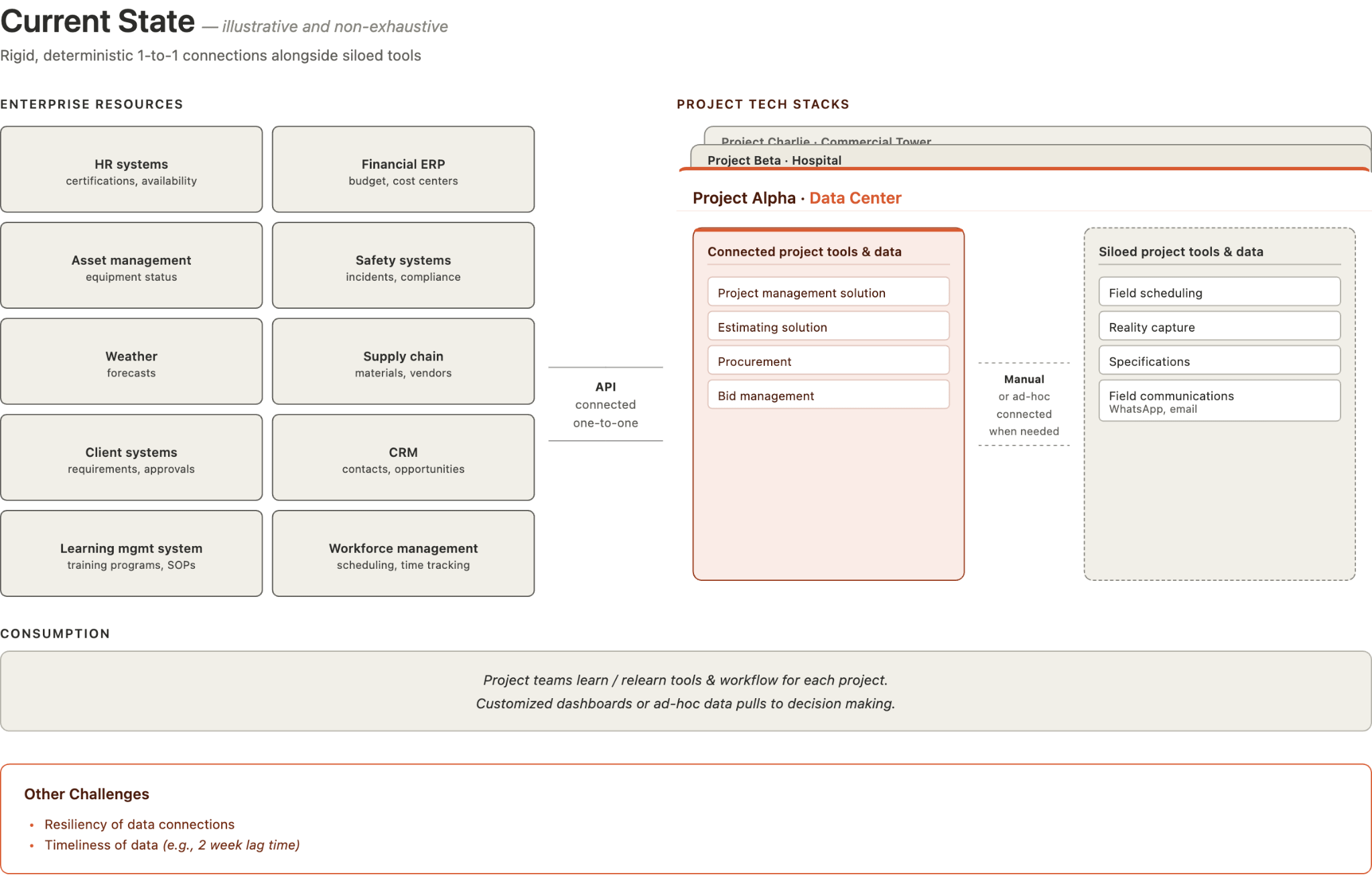
Today’s stack is akin to a hard-wired electrical system. Tools, when connected at all, are wired point-to-point to a single project. That means every project rewires from scratch and teams learn (and relearn) the layout each time. It works, but only if nothing changes. And in construction, everything changes.
The Next Shift: The Project Operating System
Agentic AI and MCP enable a new architecture: a project-specific techstack we would call a project operating system. An integrated best-of-breed tool suite powered by an intuitive, delightful interface.
Instead of forcing every project to use the same set of tools, each project can become its own digital entity with project specific access controls, approved tools, workflows, prompts, agents, and data context.
What Agentic AI unlocks, through MCP, is closer to a smart grid. It standardizes outlets allowing ‘devices’ to plug in as the project needs evolve so that data flows to where it’s demanded.
Project Operating Systems (illustrative):
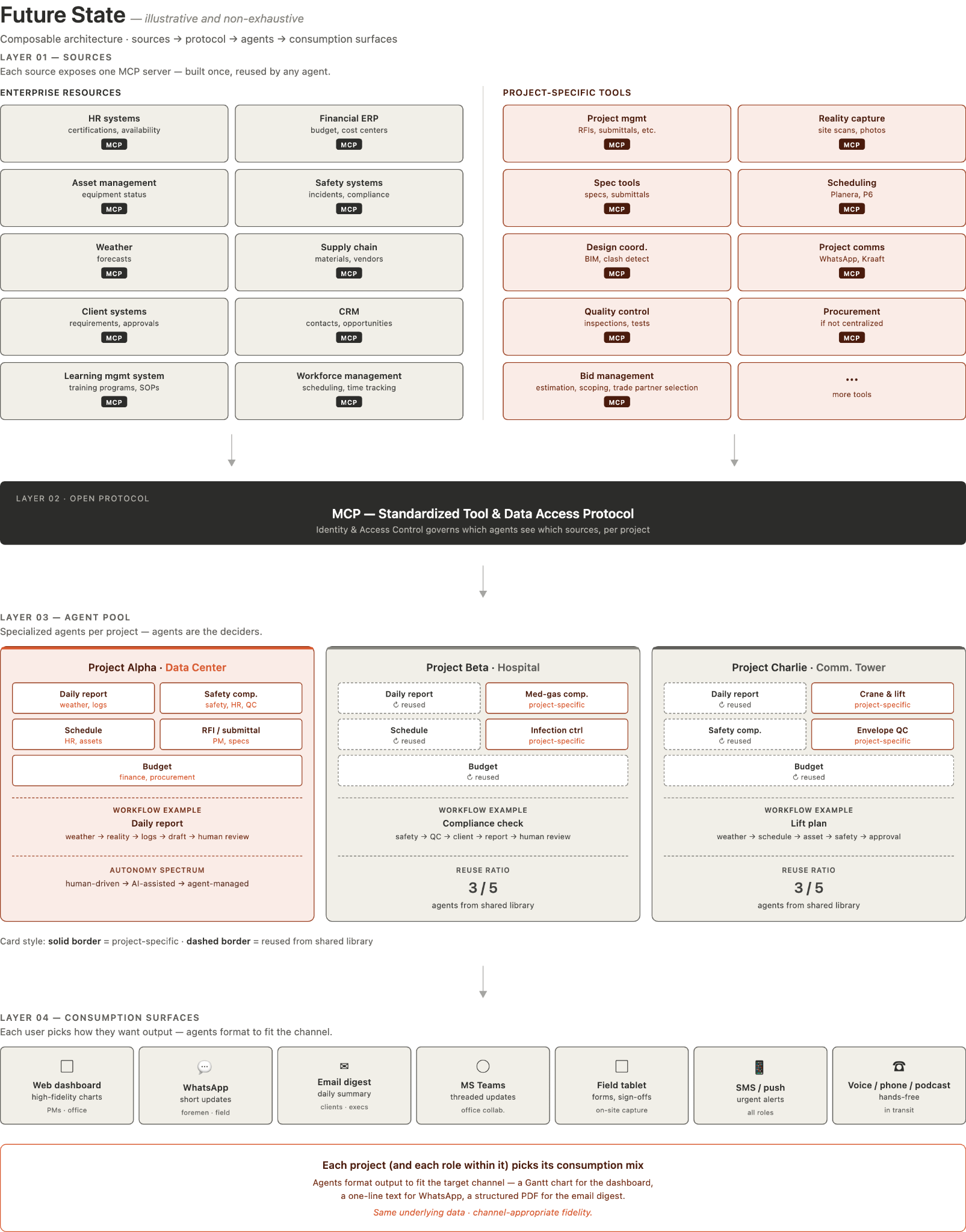
Until now, that kind of connectivity was a privilege reserved for large contractors with the budget to wire it up. Everyone else faced a familiar tradeoff: adopt the company’s standard tools, which might fit the project poorly, or use whatever fits and lose access to company data. Stitching together purpose-built tools for an “n of 1” project rarely cleared the ROI bar. Agentic solutions and their associated protocols collapse the cost of that connectivity, which means projects can keep their autonomy and stay connected at the same time.
Cheap connections alone would just create noise, though. What makes MCP powerful is discovery: calling the right tool for the right job. Even when a dozen tools are available to a project, an agent interfaces only with the ones a specific task actually needs to deliver the outcome.
How This Shows Up In Daily Work
Take a daily report. Today, a project engineer gathers weather, labor, photos, safety notes, deliveries, equipment status, schedule updates, open issues, and document references from several systems. The work looks clerical. In practice, it requires context and judgment.
In a project operating system, an agent identifies which tools are relevant to that project and that report. It pulls from weather feeds, reality capture (LiDAR for the hospital, photogrammetry for the commercial build), workforce logs, schedules, document management, and safety systems. It compiles a draft and routes exceptions for review, all without touching unrelated systems or asking anyone to learn a new suite of tools.
The same underlying data can then surface differently for different people. A superintendent gets a short mobile update. A project manager sees a dashboard. A client receives an email digest. Same data, appropriate fidelity.
Layer those pieces together and the shape of the shift becomes clear: temporary, contextualized, connected stacks, one per jobsite, with workflows on top ranging from fully user-controlled, to AI-assisted, to agent-managed. As software costs fall and company data becomes accessible from day one of a job, project teams can shape how they consume and interact with that data around how they actually work. The result combines the benefits of platforms, integration and visibility, with the depth of specialized tools, workflow fit, driving broader digitization and better alignment with project needs.
The architecture is becoming possible. The harder question is whether construction firms, startups, and incumbents can make it reliable enough to trust.
Part II picks up there: why agentic AI hasn’t taken off yet, how tech-forward firms are engaging with it today, and the operating choices that will determine who wins.
Founded in 2015 by Darren Bechtel, Brick & Mortar Ventures is a venture capital firm that invests globally in startups that develop software and hardware solutions for the architecture, engineering, construction and facilities management industries.